
Inside "WASHINGTON: American Hero" How These George Washington Movie Independent Filmmakers Recreate 18th Century America

Recreating 18th-century America is never just a matter of finding a field, renting a few coats, and yelling “action.” For independent filmmakers, the past has to be built one choice at a time, often with limited money, limited time, and a long list of details that history fans will notice right away.
That is what makes a production like WASHINGTON: American Hero so interesting. An independent film about George Washington and the American founding has to feel large, but indie filmmaking often means working small. The challenge is to make the frame feel full, believable, and grounded without pretending to have the resources of a major studio.
Period filmmaking starts with hiding the present
The hardest part of filming the 1700s is that the modern world keeps trying to creep into the shot.
A paved road. A power line. A vinyl window. A modern fence post. Even a stubble or machine-stitched costume can break the spell. Period filmmaking depends on subtraction as much as addition. The team has to remove, block, cover, or avoid anything that reminds the audience where they really are.
On an independent budget, that means every location must work harder. And we worked hard to find the best locations. A single farm, wooded trail, colonial building, or open field may need to stand in for several places. The camera angles become part of the production design. Shoot low enough, and focus on the value. Move ten feet to the left, and the background suddenly looks like another century.
For a project like WASHINGTON: American Hero, location scouting is not just about beauty. It is about control. Can the crew park nearby without ruining the shot? Can sound be recorded without traffic noise? Can extras move safely across the terrain? Does the land match the mood of the scene?
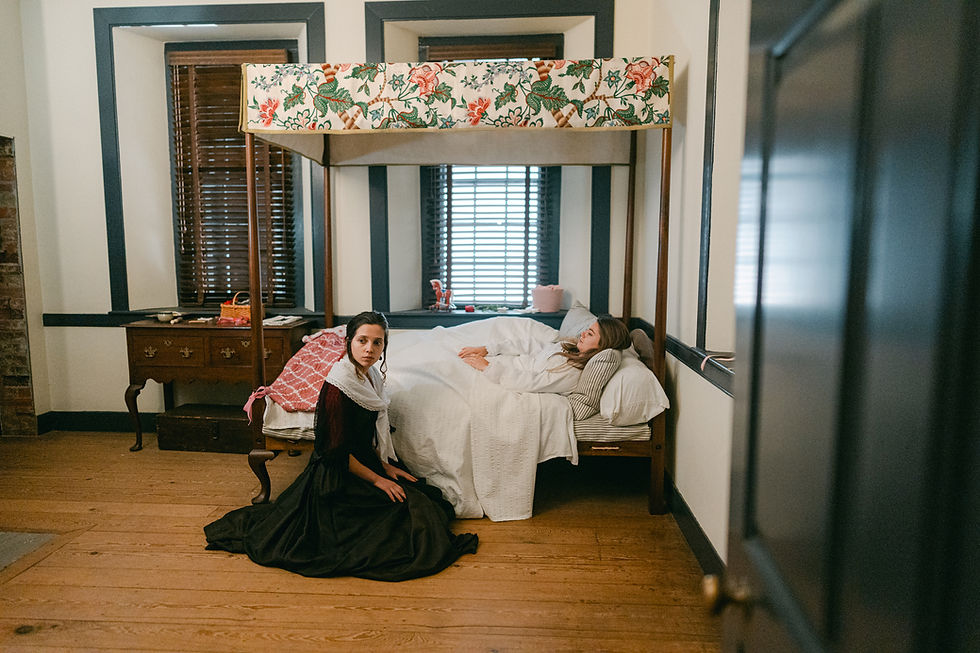
At Historic London Town and Gardens we were making use of their period-accurate kitchen. However, we also utilized the property for many other of George Washington's home-life scenes.
Costumes carry more than color
Costumes do a lot of storytelling in a period film. They tell us who has money, who has marched for days, who has slept outside, and who is trying to hold rank under pressure.
For veterans and military history fans, uniforms matter. Rank, wear, kit, posture, and how a soldier carries a musket all help sell the world. Clean costumes can look theatrical. Clothes that show mud, sweat, fading, repairs, and uneven fit often feel more truthful.
Independent productions rarely have endless racks of handmade clothing, and rentals are expensive. That pushes the costume team to make smart choices:
Use hero pieces for close-ups, where detail matters most.
Save the most accurate uniforms for key characters and featured extras.
Break down costumes with dirt, aging, and repairs to avoid a “fresh from the rental house” look.
Utilize the reenactment community's passion to translate this value to the screen.
The goal is not to make every background performer a museum display. The goal is to create a believable pattern. When the audience scans the frame, nothing should shout that it belongs to the wrong century.

For this George Washington Independent Film, Battle scenes depend on planning more than scale
Large battle scenes are where independent films face the sharpest limits. A major studio can fill a field with hundreds of extras, horses, smoke effects, stunt teams, and multiple cameras. An independent film has to create impact with far fewer tools.
That does not mean the scene has to feel small.
A battle sequence can gain power through smart blocking and careful editing. Instead of showing everything at once, the camera can stay close to soldiers as they load, brace, fire, stumble, and react. Smoke can divide the frame. Drums and shouted commands can suggest forces beyond what the camera shows. A tight shot of fear on one face can carry more emotional weight than a wide shot full of extras.
Safety also shapes every choice. Muskets, blanks, smoke, falls, and uneven ground all need planning. The more authentic the scene tries to look, the more disciplined the set has to be. Veterans often notice whether movement feels organized or random, so drilling extras in basic period movement can pay off on screen.
A strong battle scene is not only about noise. It is about geography. The audience should feel where the line is, where danger comes from, and why the characters make the choices they make.
At the Battle of Bunker Hill reenactment over 1000 re-enactors participated in the storming of the bunker. Our camera team happened to be stations right beside Netflix who was filming for a documentary.
Authenticity is built through many small choices
Authenticity can sound like a rigid rulebook, but on set it is often a series of practical decisions. Some details must be historically precise. Others need to feel right without slowing the whole production, and budget down.
The best historical films know where the audience will look. Faces, hands, weapons, flags, food, light sources, and spoken language all matter. So does behavior. People in the 18th century moved through the world differently. They wrote differently, traveled differently, waited longer for news, and understood duty, class, faith, and loyalty in ways that do not map neatly onto modern life.
For WASHINGTON: American Hero, the authenticity question goes deeper than wardrobe. George Washington is not just a famous name. He is a military figure, a political figure, and a symbol people still argue about. That means the performance, writing, and visual world need to avoid turning him into a cardboard monument.
A grounded film can show leadership as pressure. Washington can be decisive, uncertain, exhausted, restrained, or alone in command. Those human details make history easier to feel without making it shallow.

Resourcefulness is the real production value
Money buys options. Resourcefulness creates solutions.
Independent filmmakers have to ask practical questions all day: What can we borrow? What can we build? Who can we partner with? What can we shoot tighter? What can sound design suggest? What can one great prop do in three different scenes?
That mindset often leads to better filmmaking. Limits force the team to focus on what matters in the frame. A single authentic musket in close-up may do more than a dozen vague props in the background. A real historic location may carry more weight than a large but generic set. A well-rehearsed group of reenactors may bring texture that money alone cannot buy.
For history fans, that care shows. For film lovers, it becomes part of the craft. For veterans, the attention to discipline, formation, fatigue, and command can make the difference between a scene that feels staged and one that feels lived in.
We had to time filming with these big reenactment events across the country. We lined up a tour and managed to film at a total of 6 reenactments across the US.

Why this kind of film still matters
Period films do more than recreate old clothing and battles. At their best, they give audiences a way to stand closer to the choices people faced in another time.
That is why independent historical projects deserve attention. They are often made by teams who care deeply about the subject and have to fight for every convincing detail. When the result works, the audience does not think about the budget. They think about the people, the stakes, and the story.
WASHINGTON: American Hero sits in that space where history, military legacy, and filmmaking craft meet. The production has the chance to bring viewers behind the familiar image of Washington and into the hard, physical world that shaped the American Revolution.
If you want to follow the journey, support the film, and hear when screenings are announced, sign up for the mailing list. It is the best way to get updates, watch the project grow, and be among the first to know where WASHINGTON: American Hero will screen next.


Comments